
Most B2B Companies Are Sprinting When They Think They're Scaling
B2B marketing feels like momentum until it doesn't. Here's what separates a sprint from a scalable system — and how to build one while you're still growing.
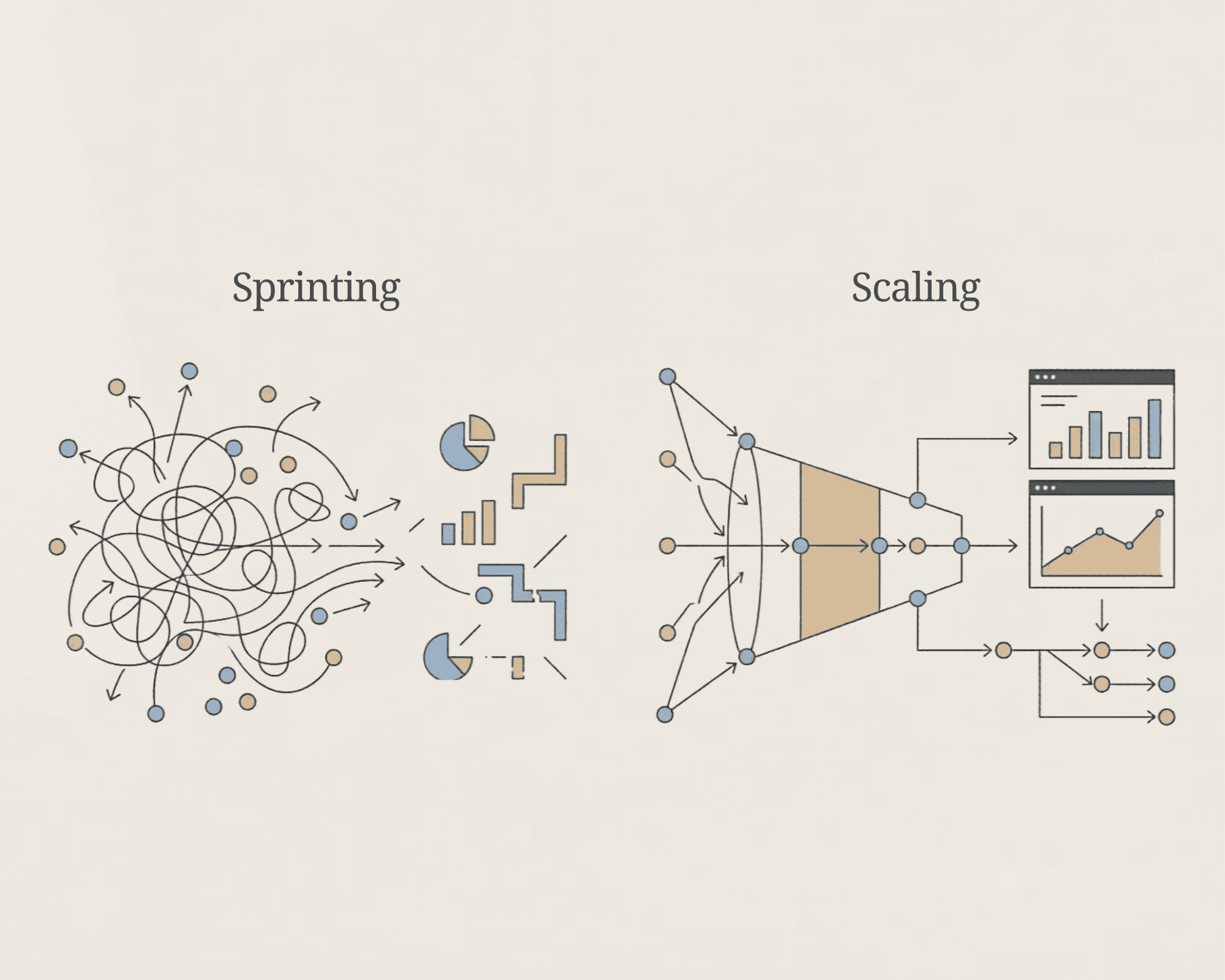
B2B companies love to talk about scaling. What most of them are actually doing is sprinting.
The difference is simple. Sprinting creates activity. Scaling creates repeatable revenue. Without a measurement system behind the motion, most companies cannot tell which one they are doing — until the sprint ends and the numbers don't add up.
Why B2B Marketing Feels Chaotic During a Growth Sprint
The pattern is recognizable. Product-market fit exists, or something close to it. A few big deals close and the directive comes down: scale the team, scale the spend, capture the market.
So headcount goes up. SDRs get hired. Paid search starts running. Each addition makes sense in isolation. What doesn't happen — because there isn't time, and because things feel like they're working — is anyone stopping to build the system that tells you whether the sprint is converting into a durable pipeline.
Funnel stages in the CRM are rough. The MQL definition was set 18 months ago and never revisited. Attribution is technically running but nobody trusts it. CAC is hard to calculate cleanly because no one agreed on which costs to include.
The company is moving fast. Numbers fill the dashboard. But nobody can tell you where they're coming from.
How to Tell When Your Marketing System Has Drifted
This kind of drift rarely announces itself. Conversion rates slip a few points. CAC creeps upward. Pipeline still looks full in the CRM, but deal quality quietly declines. The board asks a question the marketing team can't answer cleanly — then asks it again next quarter, because the numbers still don't have a clear origin.
By the time leadership has enough signal to understand what's happening, the response options have narrowed. Budgets get replanned around smaller numbers. Channels get cut. The company spends two quarters or more recovering clarity it could have maintained all along — and the recovery is rarely as fast as the drift.
What Happens When a Marketing System Outgrows Its Infrastructure
Companies big or small, new or old – we’re all susceptible to the drift. Consider HubSpot — a company that built its business on helping B2B teams get their marketing systems in order. Even they ran into this problem.
HubSpot's original pricing model charged based on total contacts in the database. That made sense when HubSpot was primarily a marketing platform. But as the company expanded into sales tools and a free CRM, the model started penalizing customers for normal product usage — sales activity generated contacts that raised the Marketing Hub bill, whether or not those contacts were ever marketed to.
The system hadn't been designed for the business HubSpot eventually became.
Leadership didn't patch the symptom. They rebuilt the structure — shifting to a model where customers pay only for contacts they actively market to. It's also the kind of structural fix that makes the product accessible to smaller teams and companies earlier in their growth who couldn't justify the cost before. Retention improved. Plan upgrades increased. The underlying economics had always been there. The system just hadn't been built to reflect them.
The point isn't that HubSpot struggled. It's that even a well-run, operationally sophisticated company can find itself operating on infrastructure that no longer fits the business it's become. If it can happen to the company that sells marketing systems, it can happen to yours.
What a B2B Marketing System Needs to Scale
The companies that sprint successfully aren't the ones with better luck. They're the ones that built just enough infrastructure to stay legible while moving fast. Not a perfect system. A functional one.
In practice, that means a small number of things. Funnel stages that reflect how leads actually move. An MQL definition that marketing and sales genuinely agreed on — and that gets revisited as the IPC evolves. Attribution that's directionally trustworthy, even if imperfect. CAC calculated consistently enough that a meaningful shift gets caught within a month, not a quarter. And defined scaling triggers — what has to be true before the next hire, the next channel, the next budget increase.
None of this requires slowing down. It requires someone asking the right diagnostic questions before the sprint begins rather than after it stalls.
When to Build Your Marketing Infrastructure
This infrastructure is best to build just before the sprint — when the funnel is still small enough to map clearly, the team small enough that one conversation can align marketing and sales, and the gaps visible before they become expensive.
Most companies skip that window because things are working and the urgency doesn't feel real yet. Then the sprint begins, the volume buries the system, and the drift sets in quietly.
But missing that window isn't a reason to wait for the next one.
If you're mid-sprint and you recognize the drift — the dashboards are active but the numbers don't tell a coherent story, the team is busy but leadership can't explain what's working — that recognition is itself the moment. I've been on teams that built the reporting layer, the funnel definitions, the attribution model, all of it, while the sprint was already underway. You're constructing the system while the business runs on top of it. It's definitely harder than building before you launch. But it's significantly better than discovering what you're missing when the numbers finally force the conversation.
The companies that scale through a sprint aren't always the ones that planned perfectly. Sometimes they're the ones that caught the drift early enough to course correct while the momentum was still on their side.
A Simple Test: Are You Sprinting or Scaling?
Before the next planning cycle, three questions worth answering honestly:
Do marketing and sales share the same written definition of a qualified lead?
Can you calculate CAC within one week of month close?
Do you know which channel produced your last ten closed deals?
If two of those answers are "not really" — the motion is there, but the system isn't. That's the gap worth closing before the next sprint begins.
The goal is never to slow down. It is to make sure that when the sprint ends, the business can read what it learned — and make confident decisions about what comes next.